
Health
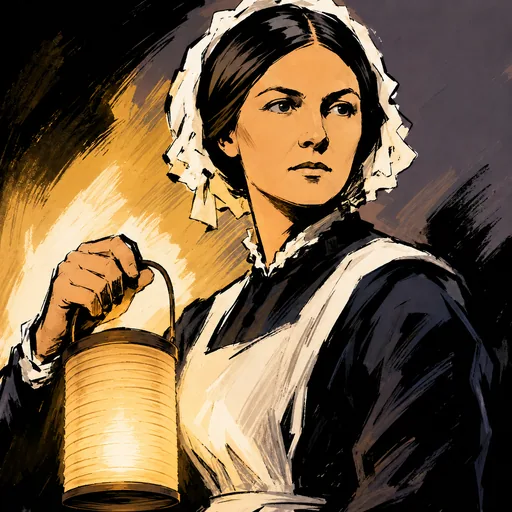
Florence Nightingale
Sanitary Hospital
Prove clean hospitals save lives.
“The world is put back by the death of every one who must sacrifice the development of her peculiar gifts to conventionality.”Read the story
Prove clean hospitals save lives.
“The world is put back by the death of every one who must sacrifice the development of her peculiar gifts to conventionality.”Read the story

Scratch, scratch, scratch.
Florence Nightingale’s pen moved across the page.
Outside her room, England went about its business. Inside, Florence worked through piles of papers about a war that had ended.
Columns. Lists. Totals.
Behind those numbers were people.
Florence had cared for sick and wounded soldiers during the Crimean War. She and her nurses had worked in crowded hospital wards, helping men who were far from home.
But kindness and hard work had not solved every problem.
Men kept getting sick. Too many died.
Florence needed to understand why—and help the people in charge understand, too.
The papers did not make that easy.
Hospitals had kept their records in different ways. They used different names for illnesses. Some information was missing. Comparing the lists was like trying to fit together puzzle pieces from different boxes.
Florence could not simply add everything up and call the answer finished.
She checked. She asked questions. She looked for better information.
And she asked for help.
William Farr was a doctor who studied what large collections of numbers could reveal about people’s health. He helped Florence examine the evidence and work out ways to show it clearly.
Slowly, the confusing rows began to tell a story.
Many more soldiers had died from disease than from battle wounds.
That mattered enormously.
A soldier could survive the fighting and still become terribly ill where he was supposed to recover.
Florence knew that caring for patients meant looking beyond their beds.
During the war, a special team called the Sanitary Commission had repaired sewers and improved ventilation at the hospitals. These changes helped make the buildings healthier. Deaths fell.
Now Florence wanted those lessons to last.
She could put the evidence into a report. She did.
But a report full of numbers was a difficult thing to place before busy people and expect them to understand.
How could she make the problem easier to see?
Florence and her helpers worked on pictures made from the numbers.
One famous design looked a little like a flower.
Around each circle were twelve sections, one for each month. Different colors represented different causes of death. Larger colored areas showed higher death rates.
Blue showed preventable disease.
In the circle for the earlier year, huge blue sections spread across the page.
In the circle for the following year, they were much smaller.
There it was.
A reader did not have to search through every row of a long table to notice the difference.
The picture could catch someone’s attention. The careful numbers behind it could explain what they were seeing.
In 1858, Florence included these diagrams in her work urging improvements in army health. She sent her findings to people who could help change things.
The work did not end with a beautiful page.
There were more letters to write, more questions to answer, and more people to persuade. Florence kept working with others to improve hospitals and nursing.
She had learned to care for someone beside a hospital bed.
Now she was learning how careful questions, checked numbers, and a clear picture could help care reach much farther.
Scratch, scratch, scratch.
Her pen kept moving.
Would you and your child enjoy an at-home activity inspired by Florence Nightingale? It could be an experiment, a building challenge, or a mini-game. Your vote helps me decide what to create next.