
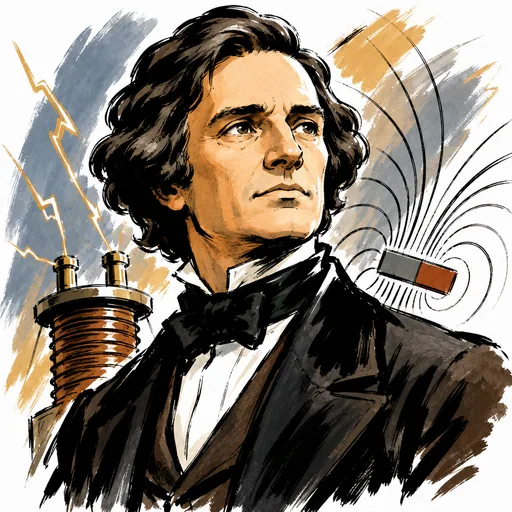
Energy
Michael Faraday
Electromagnetic Induction
Discover how motion can be transformed into electric power.
“Nothing is too wonderful to be true, if it be consistent with the laws of nature.”Read the story
Discover how motion can be transformed into electric power.
“Nothing is too wonderful to be true, if it be consistent with the laws of nature.”Read the story

Imagine watching a tiny needle so closely that you almost forget to blink.
Michael Faraday had a reason to watch.
It was August 29, 1831. In his basement laboratory in London, an iron ring sat wrapped in coils of copper wire. A battery stood nearby. Long wires stretched across the table toward a small magnetic needle.
The ring was about as wide as a small plate.
The question it might answer was much bigger.
Years earlier, a scientist named Hans Christian Ørsted had shown that electricity flowing through a wire could move a compass needle. Electricity could produce magnetism.
Michael wondered how magnetism could produce electricity.
He had been trying to find out for years.
Now he had a new arrangement to test.
Someone had made him an iron ring. Michael wound wire around one side, then around the other. Round and round, carefully separating the coils with cloth and string.
The two sides shared the iron ring, but their wires did not touch.
One side would connect to the battery.
The other would connect to the needle detector.
If electricity flowed in that second set of wires, the needle could show it.
Imagine the patience those coils required. Another turn. Another layer. Keeping one wire from touching another. A tangle would not answer his question.
At last, Michael made the battery connection.
The needle moved!
Then it wobbled back.
And stopped.
The battery was still connected. Electricity was still flowing through the first coil. But the needle had returned to its usual place.
After all that winding, was a brief movement all he had found?
Michael broke the battery connection.
The needle moved again.
There it was: another movement, at the very moment the connection ended.
That deserved a closer look.
Michael joined more of the wire on the battery side into one longer coil and tried again. The effect grew stronger. He changed the wire arrangement near the needle so its movement would be easier to see.
Then he connected the battery.
The needle swung one way.
He waited.
It settled.
He disconnected the battery.
The needle swung the other way.
Connect. Movement.
Wait. Stillness.
Disconnect. Movement again.
The needle was not behaving randomly. Its movements followed the changes Michael made.
He recorded what happened, including the part that might have seemed disappointing: the effect did not last.
That shortness was a clue.
Today, we can explain the experiment this way: when the battery connection began or ended, the magnetism in the iron ring changed. That change produced a brief electric current in the other coil.
Once the battery current became steady, the needle settled again.
The answer was hiding in the beginning and the ending.
Michael went on testing. There were more arrangements to try, more results to write down, and much more to understand. His experiments helped open the way to machines that generate electricity and devices that transfer electrical energy between coils.
Other scientists and engineers would carry that work further.
But in the basement, the next step was close enough to touch.
A wire.
A connection.
A tiny needle.
Imagine Michael leaning forward again, ready to watch what happened next.
Would you and your child enjoy an at-home activity inspired by Michael Faraday? It could be an experiment, a building challenge, or a mini-game. Your vote helps me decide what to create next.