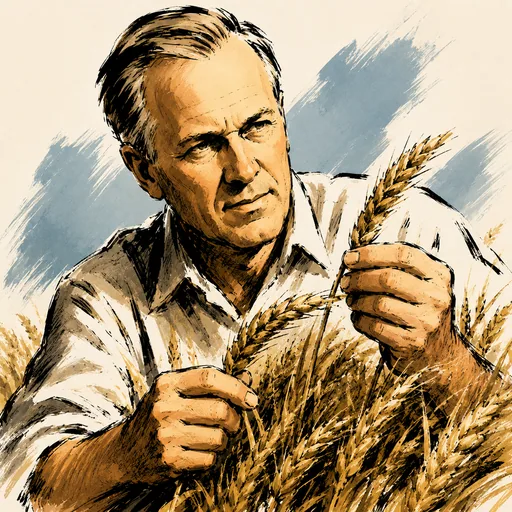
That was the goal. But in Mexico, Norman Borlaug and his fellow researchers ran into a frustrating problem.
They had bred wheat that resisted disease and produced good harvests. When farmers added fertilizer, however, the plants could grow tall and fall over in wind and rain.
The grain they wanted to harvest ended up close to the ground. Gathering it became harder.
The plants needed sturdier stems. Shorter ones could help.
A useful clue had traveled a long way. Japanese breeders had developed a short wheat called Norin 10. In the United States, scientist Orville Vogel used it in his own breeding work.
Borlaug asked Vogel for seed carrying those useful traits.
Then the Mexican team began crossing the shorter wheat with their own varieties. Their first attempt did not work. They made more crosses, grew more plants, and kept selecting and testing.
Years of work followed.
By 1962, two of the resulting varieties, Pitic 62 and Penjamo 62, were released for farmers to grow commercially.
Their shorter, stiffer stems were less likely to collapse. The plants could carry a heavy crop of grain while staying upright.
Good seed still needed water, nutrients, and knowledgeable farming. But the breeders had removed an important obstacle to a bigger harvest.
Look closely at the illustration. The long wheat on the left has fallen over. The shorter wheat on the right still stands.
Sometimes, helping something grow better means finding a way to make it smaller.
Would you and your child enjoy an at-home activity inspired by Norman Borlaug? It could be an experiment, a building challenge, or a mini-game. Your vote helps me decide what to create next.