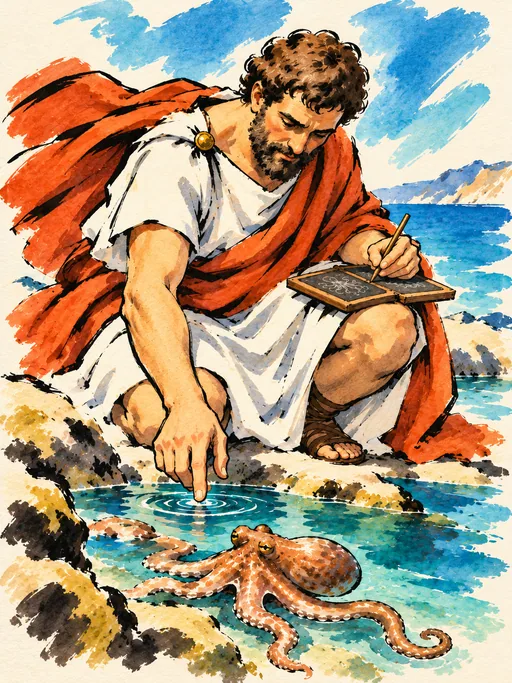
Portrait of Aristotle
Health

Aristotle

The Science of Life

Observe living things, uncover their patterns, and discover how life works.

Web game

Can you sort the animal kingdom?

Make your own groups, then compare them with Aristotle’s.

Play right here. No app to install.

“All men by nature desire to know.”
Read the story

The Chicken That Challenged a Definition

Sunlight lay in warm stripes across the courtyard. Aristotle sat among the students, listening to Professor Plato.

“What is a human being?” Plato asked.

He held up a finger. “An animal with two feet and no feathers. A featherless biped.”

Just then, Diogenes appeared with something tucked under his arm.

“I have brought you a new student,” he announced.

He gently set a plucked chicken on a stone bench. Its bare pink body wobbled on two skinny legs.

“Here is Plato’s man.”

The chicken blinked at Plato. Plato blinked at the chicken.

“Two feet,” Diogenes said, counting. “No feathers. Shall I find him a seat?”

One student snorted. Another burst out laughing. Soon laughter echoed between the columns.

Aristotle leaned forward, his hand against his chin.

“The chicken fits the definition,” he said. “But it is still a chicken.”

Plato looked down at the bird. “Then our definition has let in something that does not belong.”

“A rather noisy something,” said Diogenes.

“Cluck!” said the chicken.

Aristotle smiled. “We need a better way to say what a thing is.”

Three Sides in the Dust

Aristotle picked up a stick. In the soft dust beside the bench, he drew a triangle and a long rectangle.

“What kind of things are these?” he asked.

“Polygons,” Plato said. “Closed, flat shapes with straight sides.”

“Good. That gives us their broader kind—their genus.” Aristotle tapped both drawings. “They belong to the same group.”

Diogenes pointed at the triangle. “Then what keeps this one from being a rectangle?”

“Count its sides,” said Aristotle.

“One, two, three.”

“Exactly three sides. That is the defining difference—the differentia. A triangle is a polygon with exactly three sides.”

Genus: polygon
A closed, flat shape with straight sides.
Triangle3 sides
Rectangle4 sides · 4 right angles
Differentia of a triangle: exactly three sides.

Plato pointed at the other drawing. “The rectangle has four. It belongs among the polygons, but it cannot slip in among the triangles.”

“What if I paint it red?” Diogenes asked.

“Still a rectangle,” said Aristotle. “Color does not make it a triangle. The defining difference must tell us what makes it that kind of thing.”

Plato drew a tiny triangle beside the first. “And this one?”

“A triangle too,” Aristotle said. “Our definition must fit every triangle, big or small, and keep other kinds of shapes out.”

Diogenes glanced at the chicken. “And we had better test our definitions on real things. They can sound splendid until a chicken walks in.”

The Animal That Asked Why

“Now,” Plato said, “what about us? What is distinctive about a human life?”

Aristotle looked toward a little olive tree. “We grow and take in nourishment. But plants do that too.”

The chicken turned its head toward a sound.

“We see and hear,” Diogenes offered.

“So do other animals,” Aristotle said. “That does not yet give us the difference we need.”

For a moment, all three watched the bird.

Then Aristotle looked down at his drawings.

“We can ask what things are and why they happen. We can form ideas about whole kinds of things, like polygons. We can examine evidence, test our answers, and work out how to live.”

“You are speaking of reason,” Plato said.

Aristotle nodded. “A human being is a rational animal.”

“Animal gives the genus,” Plato said.

“And rational gives the differentia—our capacity for reason,” Aristotle replied.

Diogenes raised an eyebrow. “Then why do we make such foolish mistakes?”

“Having the ability does not mean we always use it well,” Aristotle said. “We still have to choose to look carefully, think, and check our answers.”

“Even professors?” Diogenes asked.

Plato looked at the chicken. A smile spread beneath his beard.

“Especially a professor with a new student like this one.”

The students laughed again. Aristotle knelt beside his drawings and began another triangle.

The chicken pecked at the stick.

“Careful,” Diogenes told it. “We are trying to think.”

Sources

Play the gameAnimal Sorting Game — play in your browserMeet more heroesDiscover the people behind the things you love.