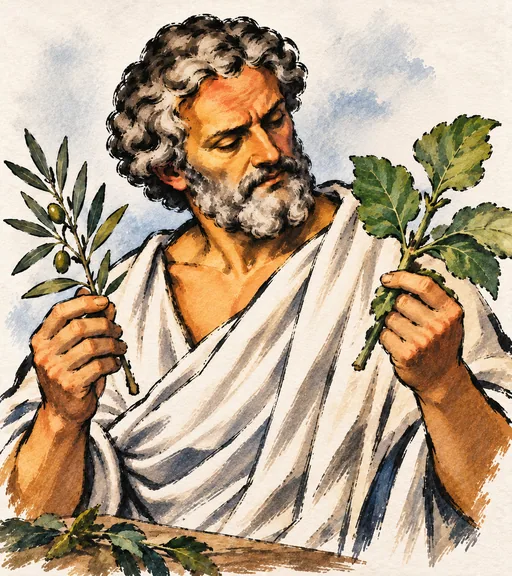
A flower, a blade of grass, an olive tree. They look so different. Yet look closer: can you find a leaf, a stem, a root? Which parts are shared, and which change?
Around 300 BCE, Theophrastus gathered observations of more than 500 kinds of plants. He compared their parts, their ways of growing, and the places where they lived. He listened to growers and other observers, bringing practical experience into a wider investigation.
He left two great botanical works. Enquiry into Plants describes plants, their structures, cultivation, and uses. On the Causes of Plants asks why they grow and behave as they do. His achievement was much larger than a list of leaves: it was a systematic attempt to understand plant life.
The same parts, astonishing possibilities
A leaf can be broad or narrow. A stem can be woody or soft. Fruit may hang from a branch or grow against a trunk. Theophrastus compared not only which parts a plant had, but their shape, size, number, and arrangement.
In the studio above, change one part and watch the whole flower change. Then compare your imagined plant with real species. Which features match? Which do not? A resemblance starts a question; it does not settle a plant’s identity or prove that two plants are close relatives.
Knowledge a grower could use
Theophrastus recorded a striking practice among date growers: they shook the flower dust from a male palm over a female palm to help her fruit develop. He did not invent the technique. He preserved a grower’s knowledge and examined it as part of a larger inquiry into how plants reproduce.
His books also discuss growing plants from seeds and cuttings, suitable soils, and sowing seasons. Some explanations were mistaken. The lasting contribution was to collect observations, compare cases, and look for causes that other people could investigate.
Were his books beautifully illustrated?
Beautiful illustrated editions exist, but their pictures are later additions. A celebrated Amsterdam edition of 1644 includes hundreds of botanical woodcuts, made roughly nineteen centuries after Theophrastus. We should not mistake those images for drawings by the ancient author.
Our flower studio takes inspiration from the later tradition of botanical books: fine pen lines, translucent color, and close attention to living forms. It is a modern creative activity inspired by his comparative approach.